Legionella and showers: the critical point in the building
The storage temperature is right, the annual test came back without objection, and yet the Legionella risk in your building is decided at a point none of those records fully covers. It hangs on the wall of every bathroom, it runs for minutes at a time, and it does so directly in front of the face of whoever is standing under it.
Why the infection runs through the air
Legionella makes people ill when it is breathed in. The usual route runs through the air: the water turns into a fine mist, and that mist reaches the lungs with the next breath. That is how the Robert Koch-Institut (Germany's public health institute) sets it out in its guidance on legionellosis. Drinking, by contrast, is not a relevant route of infection, because stomach acid renders the bacteria harmless. It becomes relevant only when water goes down the wrong way and reaches the airway instead of the stomach.
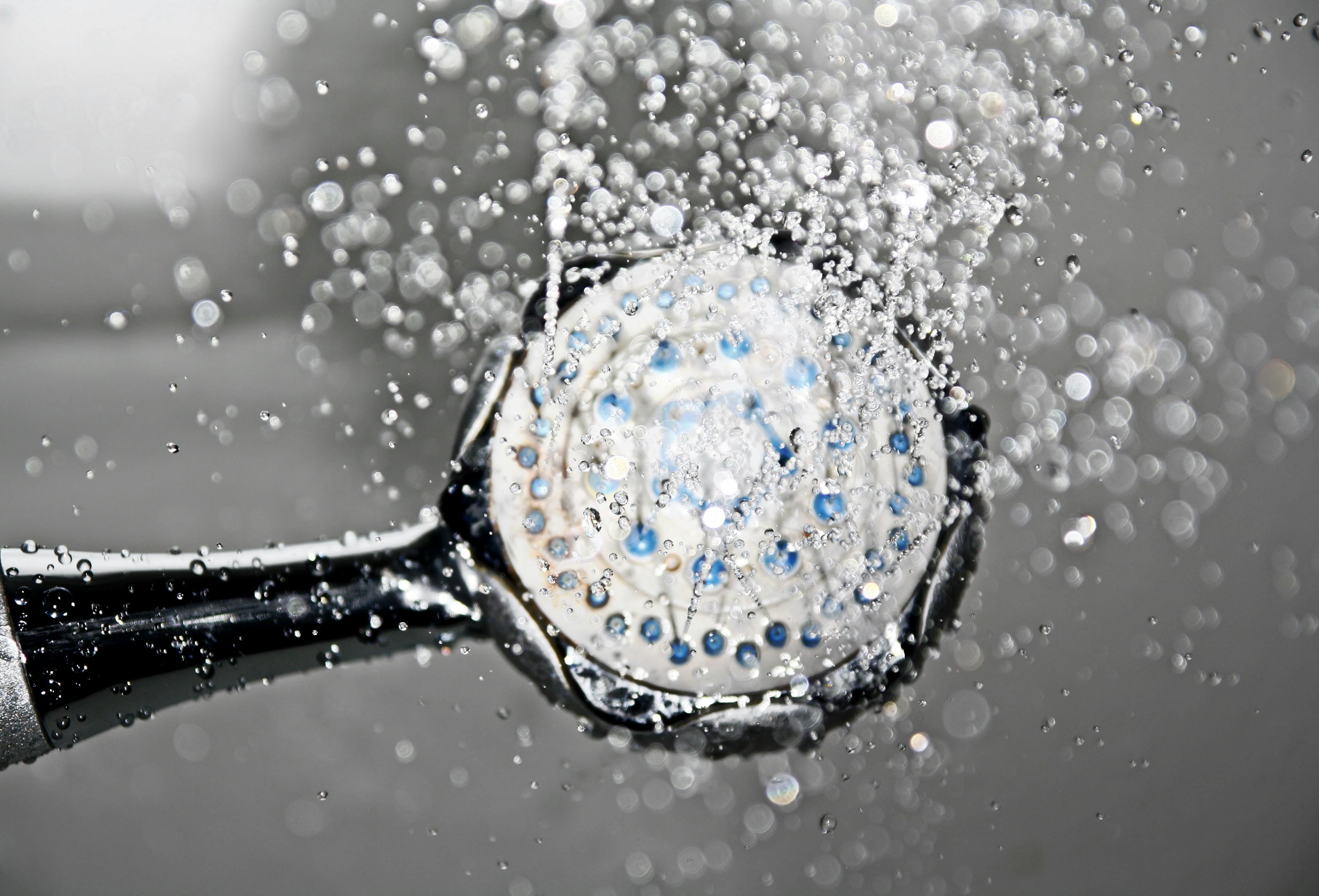
The shower produces exactly that mist. The shower head splits the jet into tiny droplets, it keeps doing so for several minutes, and the mist hangs at head height in a small, warm bathroom. That is precisely where the person underneath is breathing. No other outlet in the building produces so much of it for so long.
Route of infection
Inhaled, not swallowed
- Water carrying Legionella at the outlet. Whether it turns into an illness is decided by the route it takes.
- Breathed in as a fine mist: this is how legionellosis normally arises. The shower produces exactly that mist, for minutes and at head height.
- Swallowed: not a relevant route of infection. It becomes relevant only if the water goes down the wrong way into the airway.
The shower is not the only place where water is atomised, and the statute says as much: § 31 TrinkwV speaks of showers or other fixtures in which drinking water is atomised, which in practice also covers whirlpools or humidifiers. The shower is simply the largest of those places, and the only one a person voluntarily stands under for minutes. Why the bacteria multiply in the system in the first place is covered in the basics on how Legionella develops in drinking water.
Nobody keeps the last stretch to the shower head warm
Hot water is pumped around the building in a continuous loop so that it arrives hot everywhere. It leaves the storage tank at 60 °C or more and should not fall below 55 °C on that loop; that is what DVGW W 551 (the German technical standard for hot water and Legionella) sets out as a generally accepted rule of technology. That loop is called the circulation, and it stops short of the shower. The last piece of pipe up to the shower head branches off it, and along that piece nothing holds the temperature.
How long that last piece may be is set by the so-called three-litre rule: if it holds no more than three litres, it needs neither a hot water loop of its own nor trace heating, meaning a heating cable along the pipe. Those same three litres appear again in § 31 TrinkwV: if at least one pipe between the storage tank and the outlet holds more than three litres, your installation is one of those that has to be tested.
The three-litre rule
Where the stretch that is kept warm ends
That stretch is deliberately short, but it is there. As soon as someone turns the shower off, the water inside it cools down and passes through the band between 25 and 45 °C, where Legionella finds its best growth conditions, and the longer nobody turns the tap on, the longer it stays there. Then there are the shower head and hose themselves, where residual water sits, and deposits and biofilm build up on the inner surfaces.
For you that means the record of your storage temperature describes the system as far as the circulation loop. It says nothing about the water somebody will breathe in under the shower tomorrow morning.
Which showers in your building are actually at risk
Not every shower in the building is a problem, and that is the part that takes the pressure off. A shower somebody stands under every day exchanges its own water, more thoroughly than any flush does. The risk sits above all where nobody turns the tap on for a longer stretch of time.
In a hotel that is the room that has not sold in three weeks, the wing that stays closed from November to March, and the accessible room that is occupied less often. In a care home it is the room after a resident moves out, and the bathroom in the wing currently being renovated. In a clinic it is the patient shower that stays dry for days between two admissions.
Then there are the showers nobody thinks of, because they do not look like showers: the hand shower over the bathtub, the second wet room in the suite, the staff shower in the basement. Each of them is its own outlet with its own clock.
So the real work is not the flushing; it is the question that comes before it: which shower is due today? The booking system knows whether room 214 was occupied; it does not know whether anybody showered in it. And even when the list is right, everything depends on no door being missed on the round and on every run lasting long enough. In case of doubt, people flush everything and let every run go generously longer.
How much time you have is fixed: VDI/DVGW 6023 (the German hygiene standard for drinking water installations) requires water to be drawn off, and thereby exchanged, at every point in the installation within 72 hours, whether through use or through deliberate flushing. If the exchange fails to happen for longer than that, the same standard treats it as an interruption of operation. When those 72 hours actually start running is the second open question, and we settle that in the piece on the 72 hours and their starting point.
What the lab result does not tell you about the shower
The test examines the installation, not the fitting. Before sampling, aerators and other devices are removed. And a sample taken directly at the shower head is expressly not permitted for systemic testing, according to the recommendation of the Umweltbundesamt (Germany's federal environment agency). The reasoning is sound: the lab is meant to assess the system, not the component at the end of the pipe.
So a clean result is good evidence that your system is in order, and says nothing about what has built up in the last few centimetres before the shower head. How often testing is required, and under what conditions, is covered under Legionella testing; the duty only applies when four conditions come together in the first place, and the shower is one of them.
Conversely, the shower is the first thing to close when a result comes back high. Once the technical action value of 100 CFU (colony-forming units) per 100 ml is reached, a figure set in Anlage 3 Teil II TrinkwV (Annex 3 Part II of the ordinance), notification, risk assessment and remedial measures follow under § 51 TrinkwV. At very high readings the Gesundheitsamt (the local public health authority) restricts use, up to a full ban on showering. A building without usable showers cannot accommodate its guests or care for its residents and patients.
How to keep the shower moving
There are essentially three ways to keep the water at the shower moving. A manual flushing schedule works as long as somebody actually walks the round and logs every flush with a date and an outlet, but it founders on the question above, namely which shower is due today. Central flushing stations run automatically, yet they flush the risers, the vertical mains, and stop short of the shower. Terminal filters hold bacteria back right at the outlet and are a sensible immediate measure when a result comes back high, but they do not replace the water exchange the rules require. Alongside them are fittings and valves that trigger and log the flush at the end of the pipe themselves.
| Route | Runs automatically | Reaches the shower head | Limit in practice |
|---|---|---|---|
| Manual flushing schedule | No | Yes, if somebody walks the round | Nothing records which shower is due today |
| Central flushing station | Yes | No, it flushes the risers | Stops short of the shower |
| Terminal filter | Yes, but without water exchange | Yes, it holds bacteria at the outlet | Does not replace the required water exchange |
Source: VDI/DVGW 6023; DVGW code of practice W 551. Own illustration.
Aqvior works at the shower itself: a surface-mounted shower fitting (Aufputz-Duscharmatur) with built-in Legionella flushing — known in Germany as Hygienespülung. It fits onto the existing connection, with no bathroom refurbishment, in under an hour. It needs no power connection, because it is self-powering. And every flush lands automatically in the web dashboard, from which the compliance report downloads as a PDF.
The flush duration is set once at commissioning, instead of being estimated afresh on every run. That is prevention: the water never stands still in the first place. Aqvior therefore does not remediate an existing finding, and it does not replace Legionella testing, just as washbasins, WCs and kitchen taps keep their own routine. What that looks like in daily operation is clearest in any wing that stands empty for a while, whether after the season ends in a hotel, between two admissions in a care home, or on a ward being refurbished in a hospital, when the showers keep running on schedule anyway.
Frequently Asked Questions
Does a bathtub with a hand shower count as a shower under the drinking water ordinance?
Yes, if drinking water is atomised in the process. § 31 TrinkwV does not turn on the design of the fixture but on showers or other fixtures in which drinking water is atomised. A hand shower over the tub atomises water just as a fixed head does, and therefore belongs in the flushing schedule.
Why is a brief turn of the tap not enough after a long standstill?
Because it only changes the water in the head and hose, not the water in the supply pipe. That pipe holds the volume nobody has moved for days. How long to flush, and under what conditions, is covered under hygiene flushing.
Are the shower head and hose included in Legionella testing?
No. Aerators and other devices are removed before sampling, and a sample taken directly at the shower head is not permitted for systemic testing. The result describes the installation. What has settled inside the shower head remains a matter of cleaning, replacement and regular water exchange.
May showers still be used after a Legionella finding?
That is for the health authority to decide, not the operator. Once the Maßnahmenwert (technical action value) is reached, notification and risk assessment follow, and depending on how high the reading is the authority imposes restrictions, up to a ban on showering. Which measures apply after that depends on the cause and belongs in the hands of a specialist firm.
Is a terminal filter at the shower enough?
Not as a permanent solution. Terminal filters hold bacteria back at the outlet and are a sensible immediate measure when a result comes back high, as long as the cause is being dealt with. They do not replace the regular water exchange: filtering while leaving the water standing does not satisfy the operator's duty.
Sources
- Federal Ministry of Justice (2023): Trinkwasserverordnung (TrinkwV) – § 31 Testing obligations regarding Legionella spec. (in German)
- Robert Koch-Institut (2021): RKI guidance on legionellosis (in German)
- Umweltbundesamt (2025): Recommendation: systemic testing of drinking water installations for Legionella (in German)
- VDI: VDI 6023 Sheet 1 (2023-09) – Hygiene in drinking water installations: requirements for planning, construction, operation and maintenance (in German)
- DVGW code of practice W 551 (2004-04) – Drinking water heating and pipework systems, measures to reduce Legionella growth. The code of practice is not free to access; overview on the DVGW topic page on drinking water installation (in German)
Secure the shower without opening up a single bathroom
Aqvior flushes the shower automatically and logs every flush without gaps.
Retrofit without bathroom works · Self-powered · Logged without gaps
Stay current without going looking
Once a month: what we have published on drinking water hygiene, and what we are working on at Aqvior.
Thank you. Please confirm your email address.
The content of this article is for general information and does not replace legal, technical, or health-related advice in individual cases. Information on Legionella and associated health risks is general in nature and constitutes neither medical advice nor an assessment of a specific drinking water installation. For implementation in your operation, clarify your specific situation with the responsible Gesundheitsamt (local public health authority). This article contains links to Aqvior products.