Every 72 hours. But from when?
If you run a hotel, you know the 72-hour rule from VDI/DVGW 6023: water in every pipe must be completely exchanged at least every three days. Sounds clear. But in practice, one question remains unanswered, and it is anything but trivial: when does this deadline actually start? After the last guest? From midnight? Who is responsible when occupancy is irregular and nobody can say with certainty when the shower in room 214 last ran?
How the 72-hour window works: The standard requires complete water exchange within 72 hours at every outlet, as soon as water is not exchanged through normal use. The clock starts when the shower stops running. If it is used after 71 hours, the clock resets. If it stands longer, flushing is required. The problem for hotels: which showers last ran when is not traceable without technical support.
Why there is a deadline at all
Standing water provides ideal conditions for Legionella as soon as warmth is added. Between 25 and 55 °C they multiply exponentially, like sourdough starter at room temperature. VDI/DVGW 6023 therefore requires that all water in a drinking water installation must be exchanged after a maximum of 72 hours. This is not a recommendation but the recognized standard of engineering practice that health authorities and courts refer to when assessing how an installation is operated.
Why exactly 72 hours? Because the interval is short enough to limit the risk of multiplication to an acceptable level, provided the installation is otherwise designed and operated hygienically correctly. Longer becomes risky; shorter would be safer but often impractical. The 72 hours are thus a compromise between hygiene and feasibility that the operator must meet as soon as use alone does not ensure water exchange.
Hotels face three obligations simultaneously: they must operate the installation according to recognized engineering practice, which includes the 72-hour rhythm. They must have drinking water tested for Legionella at least once a year when the three conditions of § 31 TrinkwV coincide: a large-scale drinking water heating system (Großanlage zur Trinkwassererwärmung), showers or other installations that aerosolize water, and supply as part of a public activity. This applies to the vast majority of hotels. And they are personally liable if something goes wrong because they provided water in a condition that does not meet requirements.
When does the deadline specifically begin?
This is the question that arises in practice: does the 72-hour deadline run from the moment the shower was last used, or is there a fixed zero point, for example midnight? The answer is clear, but it means effort: The deadline begins at the end of the last use. Lack of water exchange for more than 72 hours is considered an operational interruption. There is no daily reset at midnight.
What this means concretely: if a guest showers on Monday at 9 a.m. and then checks out, the deadline begins exactly then. It runs until Thursday, 9 a.m. If the shower is not used during this time, it must be flushed by then at the latest. If a new guest checks in on Wednesday and showers, the deadline is interrupted and begins again with that use. But if the room remains empty until Friday, the 72-hour rhythm has long been exceeded and stagnation has begun.
Why this matters: because nobody can tell by eye when a shower last ran. A property management system records check-ins and check-outs, but not the moment when water last flowed through the pipe in room 214. This means the operator must either document every use, which is practically impossible, or flush earlier than necessary for safety reasons. Both cost: time, water, energy, staff.
What happens with irregular occupancy
Hotels with constant occupancy have it comparatively easy because the natural turnover of guests flushes most showers within three days. But as soon as occupancy fluctuates, it becomes complicated: the wing only occupied in summer. The rooms at the end of the corridor that are sold less often. The accessible rooms that stand empty for weeks. That is exactly where the water stands, and exactly where the risk grows.
The standard distinguishes, depending on the duration of the interruption, how to resume operation: up to seven days, flushing for at least five minutes at several simultaneously fully opened outlets suffices so that turbulent flow is achieved in the supply lines. Over seven days, but a maximum of four weeks, the standard already requires complete water exchange according to DVGW W 557. This is a cleaning and disinfection flush that only a specialist contractor can perform. Longer than four weeks, and the installation must be microbiologically tested before recommissioning.
What this means for you: anyone who cannot prove when a shower last ran must, in case of doubt, flush as if the longer interruption had occurred. That is the mechanism that makes uncertainty expensive. Not the flushing itself, but not knowing which flushing is currently necessary.
What the standard means by "flushing"
Turning on a tap is not enough. VDI 6023 requires two things simultaneously: temperature constancy until reasonably cold water comes, and turbulent flow. This means water must not only run until it feels cool, but it must flow through the pipe at sufficiently high speed to also flush the supply lines. For individual pipes, you achieve this by turning the shower on fully. For distribution pipes, several outlets must be open simultaneously, otherwise the water remains standing in the supply line even if it runs at the individual shower.
This is why manual flushing is so time-consuming: it is not enough to go through all rooms one after another. For supply lines, several showers on the same riser must run simultaneously. This means several people at the same time, at different locations, with precisely timed opening times. Anyone doing this alone either only flushes the final section, or needs several passes. Both fail to meet the standard or cost additional hours.
And then there is the question of how long. The correct flushing duration depends on the pipe volume: the longer the pipe, the more must drain until stagnant water is completely exchanged. Without calculation, most estimate generously because nobody wants to risk stopping too early. The imprecision systematically pushes duration upward, and every additional minute costs water, energy and working time.
How this can be solved
There are three ways to meet the 72-hour obligation: manual flushing schedules, central flushing stations, or automatic hygiene fittings directly at the outlets. All three have their justification, depending on where the installation is located and which risks are bearable.
Manual flushing schedules mean exactly that: someone goes through, opens showers, waits, documents. This works as long as the number of outlets is manageable and occupancy is stable enough to build predictable routines. The disadvantage is the effort and error-proneness, because documentation is only as good as the discipline of those executing it. A forgotten entry, an unclear time, and during inspection the proof is missing.
Central flushing stations flush at one point in the network, often at the end of a riser. They are easy to install, but they only reach the distribution pipes, not the individual branch lines to showers. For hotels with many rooms and individual supply lines, this is only a partial solution.
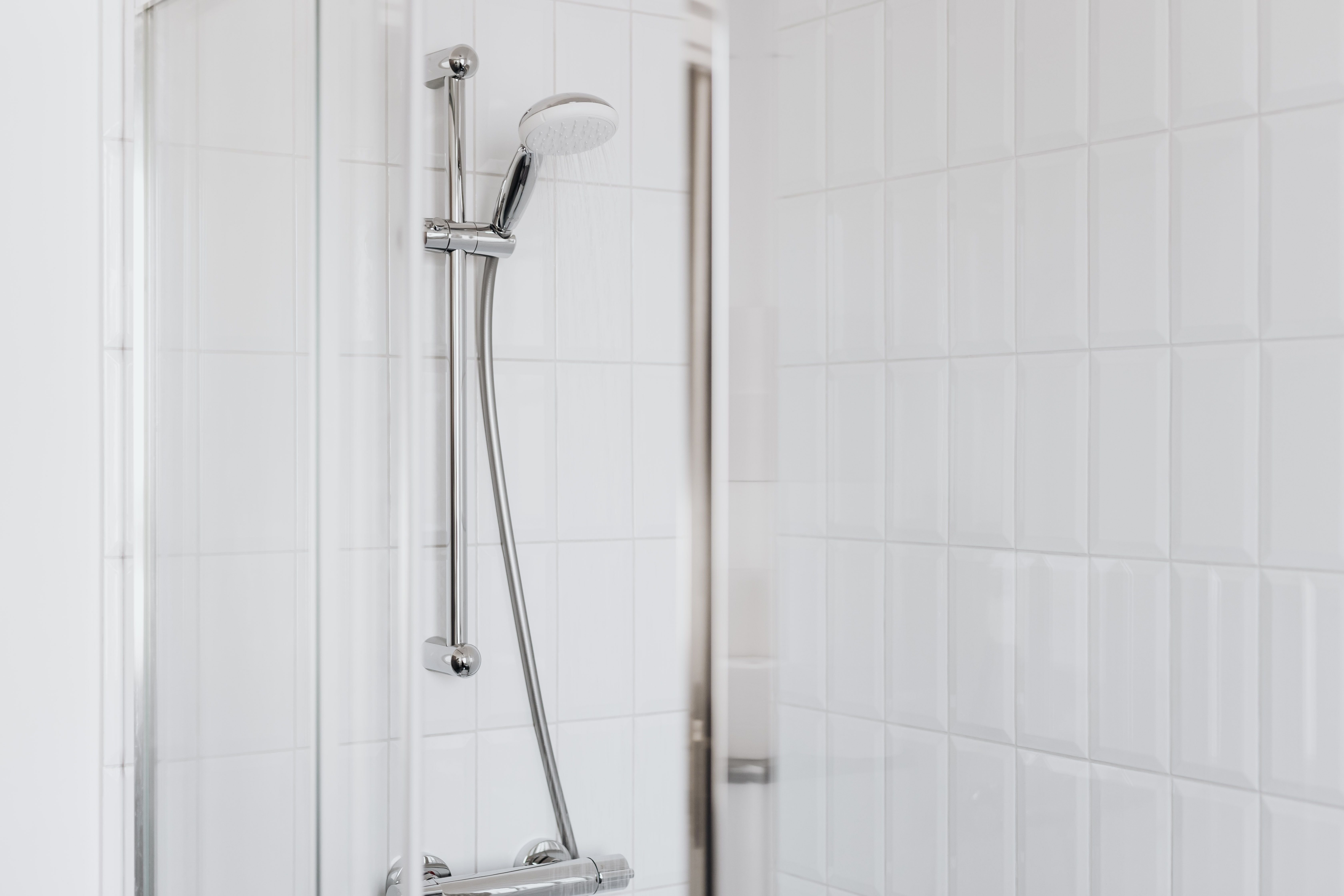
Aqvior starts directly at the shower, because that is where the greatest risk lies: the shower is the outlet with the highest aerosol volume over the longest duration, directly in the guest's breathing zone. Section 31 paragraph 1 number 2 TrinkwV names showers as a concrete example of installations where drinking water is aerosolized, and the testing obligation applies precisely when such installations are present. The surface-mounted shower fitting with integrated Legionella flushing — known in Germany as Hygienespülung — replaces the manual flushing round for precisely this critical point: it counts from the last use, flushes automatically after 72 hours, documents every flush in the web dashboard, and makes the question "from when?" a technical detail that the fitting itself manages. Retrofit, without bathroom renovation, in under an hour. Other outlets keep their own routine, but the shower, which carries the greatest Legionella risk, is secured.
Meet flushing deadlines automatically, without thinking about it
Legionella flushing runs from the moment water stands still. Aqvior counts automatically and documents seamlessly. Inspection-ready, without manual tracking.
Retrofit without renovation · Seamlessly documented · Installation in under an hour
Frequently Asked Questions
Does the deadline count from the last guest or from midnight?
The 72-hour deadline begins with the last use of the shower, not from a fixed time. If a guest showers on Monday at 9 a.m. and checks out, the deadline runs until Thursday, 9 a.m. If the shower is not used during this time, it must be flushed by then at the latest. There is no daily reset.
What happens with irregular occupancy?
Rooms that are rarely sold or stand empty seasonally are exactly the problem: water stands longer than the 72 hours allow, and without tracking nobody knows when the shower last ran. Anyone who cannot document this must, in case of doubt, flush as if the longer interruption had occurred, which is more expensive and time-consuming.
Must I track daily when each shower was last used?
Not daily, but every 72 hours. Practically this means: either you document every use, or you flush more often than necessary because you do not know. Both cost. Automatic hygiene fittings count automatically from the last use and document every flush, so you neither have to track nor guess.
Sources
- VDI/DVGW (2022): VDI/DVGW 6023 Sheet 1 – Hygiene in drinking water installations (in German)
- Bundesministerium der Justiz (2023): § 31 TrinkwV – Testing obligations regarding Legionella spec. (in German)
- Bundesministerium der Justiz: § 73 IfSG – Administrative offense provisions (in German)
- Bundesgesundheitsministerium (2023): Drinking Water Ordinance and Legionella – Core text (in German)
The content of this article is for general information and does not replace legal, technical, or health-related advice in individual cases. Information on Legionella and associated health risks is general in nature and constitutes neither medical advice nor an assessment of a specific drinking water installation. For implementation in your operation, clarify your specific situation with the responsible Gesundheitsamt (local public health authority). This article contains links to Aqvior products.